
 By Admin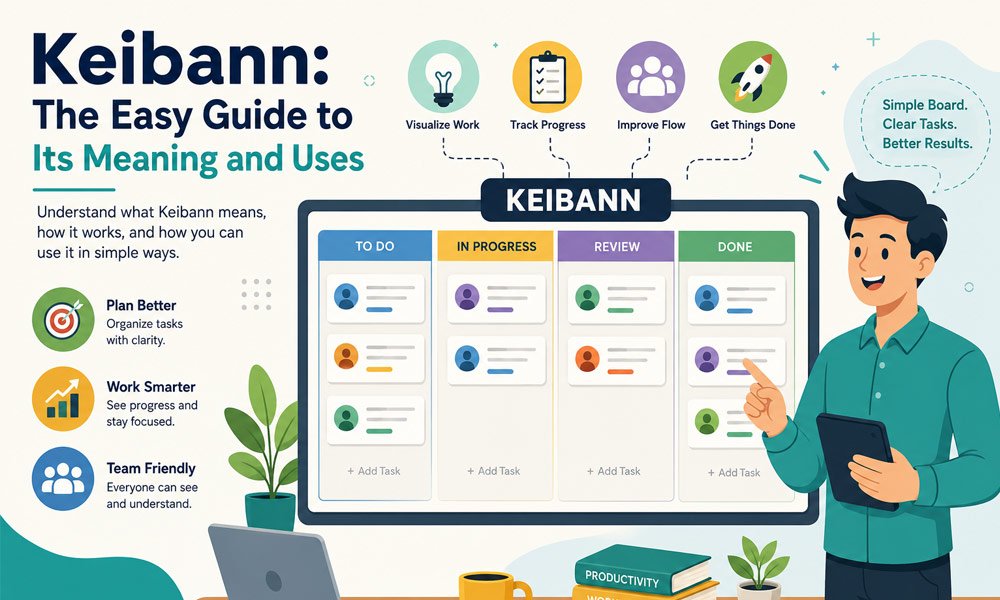
You may have seen the word Keibann while searching online and wondered what it means. You are not alone. The word has started to appear in blog posts, search results, and online talks. Yet finding one clear answer can be hard. One page may link it with task planning, while another may give a very different meaning.
This is because Keibann does not have one clear and widely accepted meaning in 2026. Most online uses connect it with visual task planning and simple ways to manage work. The idea often looks a lot like Kanban. However, the two words should not be treated as the same without clear proof.
In this guide, we will explain Keibann in very simple words. We will look at what it may mean, where the term came from, how a Keibann-style system may work, and how it compares with Kanban. We will also explore how people may use the idea for daily tasks, school, work, teams, and content planning.
What Is Keibann?
Keibann is an online term that is often linked with visual task planning. In simple words, it may describe a way to put your tasks into clear stages. You can see what you need to start, what you are doing now, and what you have already finished.
For example, think about your daily work. You may have five things to do. Instead of writing them all on one long list, you could place them under headings such as “To Do,” “In Progress,” and “Done.” When you start a task, you move it to the next stage. When you finish it, you move it to “Done.” This gives you a quick view of your progress.
Still, there is an important point to know. Keibann does not appear to be a widely accepted or standard work method like Kanban. Different online pages use the word in different ways. Some link it with work boards. Others talk about a possible digital service or brand. A few even mix it up with words linked to small Japanese vehicles. This is why the topic around Keibann can feel confusing.
Where Did Keibann Come From?
The exact start of the word Keibann is not clear. It does not have the long and well-known history that Kanban has. Instead, the word seems to have gained notice through websites, online articles, and search results.
Some writers believe the word may have grown from spelling confusion around Kanban or other similar words. That is possible, but it should not be stated as a proven fact. There is no clear source that gives one official story about who created the term or when it first began to be used.
This lack of a clear history is one reason readers should be careful with strong claims. If one website says Keibann is a new work method and another calls it a digital platform, both claims need proof. For now, it is safer to see the word as an emerging online term whose meaning can change based on the topic around it.
How Does Keibann Work?
When Keibann is used to talk about task planning, the idea is very simple. Work is placed on a visual board. The board is split into stages, and each task is shown as a card or note. As the work moves forward, the task moves from one stage to the next.
A basic board may have four stages: “To Do,” “In Progress,” “Review,” and “Done.” Imagine you need to write a school report. At first, the task sits under “To Do.” Once you start writing, you move it to “In Progress.” After writing, it can move to “Review.” When everything is ready, it moves to “Done.”
You can also add a “Blocked” stage. This is useful when a task cannot move forward. Maybe you are waiting for a file, an answer, or help from another person. Seeing blocked work on the board makes the problem easy to notice. The main goal is not to make a fancy board. It is to make your work easier to see and manage.
Keibann vs Kanban: What Is the Difference?
Keibann and Kanban can sound and look similar. They are also often discussed around the same idea of visual work boards. This can make people think they are simply two names for the same system. That is not quite right.
Kanban is an established method with a known history. Its roots are linked with Japanese manufacturing, and its ideas later became common in many other types of work. Today, people use Kanban boards in software work, marketing, business, content planning, and many other areas. The method helps people see work, control how much work is active, and improve the way tasks move from start to finish.
Keibann is different because it does not have the same clear and widely accepted base. Online articles often describe a Keibann-style board in a way that looks much like Kanban. However, this does not make Keibann an official new form of Kanban. It is better to say that the way Keibann is often explained online has many similar ideas.
Popular Uses of Keibann
One reason the Keibann idea may seem useful is that a visual board can fit many kinds of work. You do not need to run a large company. A student, freelancer, writer, small team, or busy person can all use a simple board.
For daily life, you could use one to track homework, house tasks, plans, or small projects. A student may have sections for “Not Started,” “Working On,” and “Finished.” A freelancer may have “New Work,” “Active Work,” “Waiting for Client,” and “Done.” The names can change based on what you need.
Businesses can use the same idea on a larger scale. A team may track new jobs, active work, checks, and finished work. This gives everyone a quick view of what is happening. The useful part is not the name Keibann itself. The useful part is having a simple visual system that shows where each task stands.
Keibann for Personal Tasks
Have you ever made a long to-do list and then felt unsure about where to begin? This is a common problem. A list may show everything you need to do, but it does not always show what you are working on right now. A Keibann-style board can make that easier to see.
For example, imagine you have homework, a room to clean, an email to send, and a project to finish. You could place all four tasks in “To Do.” Pick one or two to start and move them into “In Progress.” Once a job is finished, move it to “Done.” You can now see your progress without reading the whole list again.
The key is to keep the board simple. Adding too many stages, labels, or small tasks can make it messy. You also do not need to put every part of your life on one board. A small board for your most important work may be much easier to use.
How Teams Can Use Keibann
A visual Keibann-style board can also help a team understand what everyone is doing. Each task can show the person working on it, its due date, and its current stage. This can reduce the need to keep asking, “Is this task finished yet?”
Imagine a small team working on a website. One person writes the text. Another makes the images. Someone else checks the final page. Each job can move across the board as it is completed. Everyone can quickly see which work is ready and which work still needs attention.
A board can also make delays easier to find. If many tasks stay in “Review” for a long time, the team knows that checking work may be slowing everything down. If too many jobs are “In Progress,” people may be trying to do too much at once. This makes a visual workflow useful for seeing problems early.
Keibann for Content Creators
Content creators often work on many things at the same time. There may be new ideas to research, articles to write, images to prepare, pages to check, and posts waiting to go live. Keeping all of this in your head can quickly become difficult.
A Keibann-style content board can make the process much clearer. For example, the stages could be “Ideas,” “Research,” “Writing,” “Editing,” “Images,” “SEO Review,” “Scheduled,” and “Published.” Each article moves forward as the work is completed.
This also helps you spot slow parts of your content process. If ten articles are waiting under “Editing,” but only one is in “Writing,” editing may be the part causing the delay. Still, the board cannot decide whether an article is useful or correct. Good research, clear writing, accurate facts, and understanding what readers want are still important. The board simply helps you keep the work organized.
Benefits of Using a Keibann-Style System
One of the main benefits of a Keibann-style system is that it makes work easy to see. A normal list can tell you what needs to be done. A visual board can also show what has started, what is waiting, and what is finished. This can make a busy project feel much easier to manage.
It can also help you find important work faster. Imagine that you have 15 tasks on your list. Some are new, some are almost done, and a few are waiting for another person. Putting them into clear stages makes the full picture easier to understand. You can quickly decide what needs your attention first.
Teams may also find this style useful. Everyone can see the same board and understand how work is moving. It may reduce repeated questions about progress. It can also help people notice delays before they become bigger problems. The real benefit of Keibann is simple: it can make work easier to see, follow, and organize.
Limits and Problems With Keibann
There are also some limits to understand. The biggest one is that Keibann does not have one widely accepted meaning in 2026. Different websites may explain it in different ways. This makes it hard to treat every claim about the term as a fact.
A visual board also cannot fix every work problem. For example, a team may have a clean and well-planned board but still miss a deadline. Maybe there is too much work. Maybe instructions are not clear. Or perhaps the team is waiting for important information. A board can help people see these problems, but it cannot always solve them.
Another problem starts when a simple board becomes too complex. Imagine having 20 columns, many labels, and hundreds of cards. You may spend more time managing the board than doing the real work. This is why a Keibann-style system should stay simple. Add a new stage only when it has a clear purpose.
Is Keibann an App, Website, or Company?
This is one of the biggest questions around the term. Some online pages may make Keibann sound like the name of an app, website, company, or new digital service. However, there is no clear reason to assume that every use of the word points to one official platform.
This difference is important. A word can become popular online without belonging to one company. In the case of Keibann, many pages use the term when talking about task planning and visual work. Others may give it a different meaning. This is why readers should always check the source and the topic around the word.
If you find a website or app using the Keibann name, look for clear details about who runs it and what it does. Do not assume that it is connected with every article using the same word. A real service should explain its purpose, features, rules, and contact details clearly.
Is Keibann Safe to Use?
The word Keibann itself is not something that can be called safe or unsafe. Safety becomes important when the name is linked to a real website, app, download, or online service. Since the term can have different uses, each service should be checked on its own.
Before joining an unfamiliar website, look for basic signs that can help you judge it. Check whether the site uses HTTPS. Read its privacy policy and terms. Look for real contact details and clear information about the people or company behind it. You can also search for trusted reviews from people who have used the service.
Be more careful if a new site quickly asks for private or payment details without explaining why. A lack of information does not always mean a website is bad. Still, it gives you a good reason to check more carefully. These simple safety steps are useful for Keibann and any other new online service.
How to Make a Simple Keibann Board
You do not need a complex app to try a Keibann-style workflow. You can start with a simple digital board or even paper notes. First, decide what type of work you want to manage. It could be school work, articles, a personal project, or tasks for a small team.
Next, create a few clear stages. A simple board could have “To Do,” “In Progress,” “Review,” and “Done.” Write each task on its own card or note. If you work with other people, you can also add the name of the person doing the task and its due date.
Now start moving the tasks as the work changes. If something cannot move forward, you can mark it as blocked. Check the board often and remove old work when it is no longer useful. Do not add more stages just because you can. A good Keibann board should save time, not create more work.
For example, a simple board may work like this:
- Add the work you need to do.
- Create three or four clear stages.
- Put every task in the right stage.
- Choose which tasks need attention first.
- Add an owner or due date when needed.
- Move each task as work moves forward.
- Check delayed or blocked tasks.
- Remove finished work when the board gets crowded.
After using the board for a few days, look at how your work moves. Are too many tasks sitting in one stage? Are you starting many jobs but finishing very few? These small signs can help you improve the way you work.
Conclusion
Keibann is an interesting online term because its meaning is still not fully clear. In 2026, it is often linked with visual task planning and simple workflow boards. Many of the ideas described under this name look similar to Kanban. However, Kanban is the established method, while Keibann does not have the same clear and accepted meaning.
That does not mean the ideas linked with Keibann have no value. A simple visual board can help students, writers, freelancers, teams, and businesses see their work more clearly. It can show what needs to start, what is being worked on, what is blocked, and what has already been finished.
The best approach is to focus on what is useful while being careful with claims that have no clear proof. Keep your board simple. Update it when work changes. Use it to spot delays and stay focused. If the meaning of Keibann becomes clearer in the future, more trusted information may help explain exactly where the term came from and how it should be used.
For more similar articles, visit Elettro Solutions