
 By Admin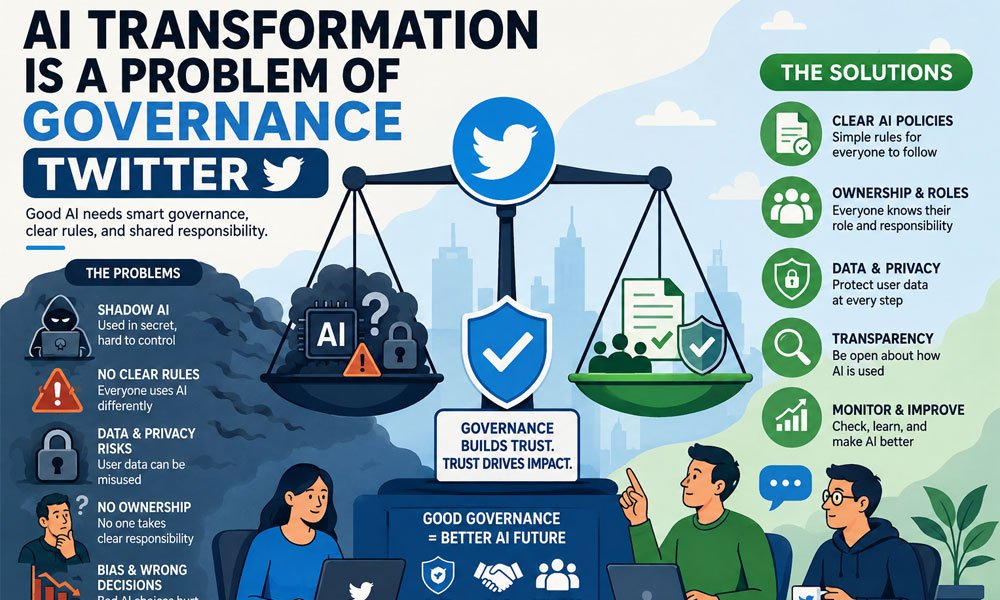
AI is moving fast in 2026. Companies are using it to write content, study data, help customers, spot fraud, and make daily work faster. Some businesses are also testing AI that can take actions on its own. With so much progress, it may seem that AI transformation should be easy.
But there is a problem. A company can have a good AI model, enough money, and a skilled tech team and still fail to move beyond a small test. The AI may work well. The real problem can be the rules around it. Who controls the AI? Who checks its work? Who can stop it? And who takes responsibility if it makes a bad decision?
This is the main idea behind AI transformation is a problem of governance Twitter discussions. The topic is about much more than AI tools. It is about control, trust, risk, data, and human responsibility. In this article, we will explain what this idea means, why it matters in 2026, and how companies can build better AI rules.
What AI Transformation Is a Problem of Governance Twitter Means
The phrase AI transformation is a problem of governance Twitter may sound complex at first. But the idea is simple. AI transformation can fail when a company does not have clear rules for using AI. The technology may work, but the company may not know how to control it.
Think about a company using AI to help choose people for jobs. The system may study many applications in seconds. But what happens if it makes an unfair choice? Who checks that decision? Who can change it? These are not only tech questions. They are governance questions.
The Twitter or X part of the keyword points to the wider online talk around this idea. People in business and tech often debate how companies should control powerful AI systems. As AI becomes part of more important choices, this talk becomes more useful. Building a smart system is only one part of the job. Companies must also decide how that system should be used.
Why AI Transformation Is a Problem of Governance
Many AI projects begin with excitement. A team builds a tool and shows it to company leaders. The demo looks great. It saves time and may even cut costs. Everyone wants to move forward. Then the project reaches the point where it must be used across the real business.
This is where things can slow down. The legal team may have questions. The security team may worry about private data. Business leaders may not know who should approve the system. The AI team may be ready to launch, but nobody has clear power to say yes.
That is why AI transformation is a problem of governance in many cases. Better software cannot fix unclear ownership. A faster model cannot decide who should carry the risk. Companies need clear rules, clear owners, and a simple way to make important choices.
AI Governance vs AI Technology
AI technology and AI governance are not the same thing. Technology is about building the system. Engineers may create the model, connect data, build an app, and make sure everything works. Their job is to give the AI the power to perform its task.
Management has another job. Managers decide how the AI fits into daily work. They may watch costs, set goals, manage teams, and check whether the system is helping the business. They focus on getting useful results from the technology.
Governance sits above these areas. It sets the rules. It decides who can approve an AI system, what it is allowed to do, how much risk is acceptable, and when a human must step in. A company needs all three parts. Great technology with weak governance can still create a serious problem.
AI Transformation Is a Problem of Governance Because of Decision Rights
One of the biggest questions in AI governance is very simple: Who gets to decide? This is what decision rights are about. A company needs to know who can approve an AI system, who owns its results, and who has the power to stop it.
Imagine that an AI system helps a bank study loan requests. It may suggest that one person is too risky for a loan. If that choice is questioned, the company cannot simply say, “The AI decided.” A human or business team still needs to own the result.
This is why AI transformation is a problem of governance when decision rights are not clear. Every important AI system should have a clear owner. There should also be a way for people to review or override important AI choices. Clear decision rights make it much easier to act when something goes wrong.
Why AI Governance Has Become a Bigger Problem in 2026
AI governance matters even more in 2026 because AI can now do much more than it could a few years ago. Companies are moving beyond simple chat tools. They are testing AI agents that can complete tasks, use business tools, start work, and take actions with less human help.
Rules are also becoming more important. Governments and regulators are paying closer attention to how AI is used. The EU AI Act is one major example. Companies using AI for important areas may need stronger records, risk checks, human control, and clear information about how their systems work.
At the same time, companies have another challenge. Workers can easily find AI tools online. A person may start using an outside AI service because it makes a job faster. The company may not even know this is happening. That brings us to one of the biggest AI governance issues today.
AI Transformation Is a Problem of Governance When Shadow AI Grows
Shadow AI means people use AI tools at work without full company approval or control. For example, a worker may paste company information into a public AI tool to save time. Another person may use an AI browser tool that the IT team has never checked.
This does not always mean workers are trying to break the rules. Sometimes the approved company system is slow or hard to use. Imagine needing several approvals just to use a simple AI feature while an outside tool can do the same job in seconds. Some workers may choose the easier option.
This is why Shadow AI can point to a wider governance problem. Companies need to protect private data and control risky tools. But they also need to make approved AI simple enough for workers to use. Good governance should create safe paths for AI use instead of only creating more barriers.
How Agentic AI Changes AI Governance
Agentic AI raises the risk even more. A normal AI tool may give you an answer and wait for you to decide what happens next. An AI agent can go further. It may start a task, use another system, send information, or complete part of a business process.
Imagine an AI agent helping with company purchases. Giving it useful information is one thing. Allowing it to place an order is very different. What if it reads the price incorrectly? What if it buys too much? A company needs to decide what the agent can do on its own and when it must ask a person first.
This is another reason AI transformation is a problem of governance Twitter has become an important topic in 2026. As AI gains more power to act, companies need stronger limits around those actions. The next part of our discussion will look at who should own these systems, the main pillars of good AI governance, how companies can watch AI after launch, and what weak governance can really cost.
AI Transformation Is a Problem of Governance Without Clear Ownership
AI needs a clear owner. This may sound simple, but many companies still struggle with it. The tech team may build the AI. The legal team may check the rules. The security team may protect the data. But who is responsible for the final result?
This is where AI transformation is a problem of governance becomes easy to see. If everyone shares the job, it can become hard to know who should act when a problem appears. A company needs a clear person or group with the power to make important AI choices.
Other teams still have important roles. Legal teams can check rules. Security teams can look for risks. Data teams can check the quality of information. Business leaders can make sure AI supports company goals. The key is to make each role clear before the AI system goes live.
The Main Pillars of Strong AI Governance
Good AI governance does not need to be confusing. It starts with a few basic areas. The first is data. AI needs good data to give useful results. Companies should know where their data comes from, who can use it, and whether it is correct.
The second area is the AI model itself. Companies need to test models before launch and keep checking them after launch. They should also have rules for privacy, security, risk, and human review. Important AI choices should not be left without human control.
Trust is another key part. People should be able to understand why an important AI decision was made. This is often called explainability. Clear records can also help a company see what happened if something goes wrong. Together, these areas create a strong base for safe AI use.
AI Transformation Is a Problem of Governance When Models Are Not Watched
Launching an AI system is not the end of the job. AI needs to be watched after it starts working. A model that works well today may not give the same quality of results months later.
One reason is model drift. In simple words, model drift happens when an AI system becomes less useful because the data or real world around it has changed. Imagine an AI tool that studies buying habits. If customer habits change but the model does not keep up, its results may slowly become less useful.
Companies can reduce this risk with regular checks, alerts, and simple dashboards. High-risk systems may need much closer checks than low-risk tools. The goal is to find problems early. Waiting for a yearly review may be far too slow for an AI system making choices every day.
Governance Debt and the Cost of Weak AI Rules
Companies often hear about technical debt. This happens when a team takes shortcuts while building software and has to fix them later. AI can create another kind of problem called governance debt.
Governance debt grows when a company uses AI without building the right rules around it. Maybe nobody keeps clear records. Perhaps the company does not know who owns the model. There may be no plan for checking errors or stopping the system. These missing controls may not cause trouble on day one, but the risk can grow over time.
The cost can be much bigger later. A company may waste money on AI projects that cannot move beyond testing. It may face legal questions, data problems, unhappy customers, or damage to trust. Fixing governance before AI grows across the business is often much easier than trying to add it after a problem happens.
How to Fix AI Transformation Governance Problems
The first step is to find out what AI the company already uses. This should include official systems and smaller tools used by workers. Companies cannot control AI systems they do not know exist.
Next, each important AI system needs an owner and a risk level. A simple writing helper does not need the same controls as an AI system helping with hiring or credit. Higher-risk AI needs stronger checks, better records, and more human review.
Companies should also keep a clear record of important AI actions. For AI agents, this can include what the system was asked to do, what tools it used, and what actions it took. This kind of audit trail can make problems much easier to study later. Rules should also be reviewed as AI tools, business needs, and laws change.
AI Transformation Is a Problem of Governance: A Simple Maturity Model
Not every company is at the same stage. Some businesses are only starting to think about AI rules. Others already have strong systems across many teams. A simple maturity model can help leaders understand where they are.
At Level 1, workers and teams use AI with few common rules. At Level 2, the company has controlled AI tests but does not have one clear system for the whole business. At Level 3, formal rules and owners are in place. At Level 4, the same governance process works across different teams and AI systems.
At Level 5, governance becomes an advantage. The company can move faster because people already know the rules. Teams know what needs approval and who makes the final call. Strong control can build trust with workers, customers, and business partners. The goal is not to reach the highest level overnight. It is to keep improving in a clear way.
AI Transformation Is a Problem of Governance Twitter: What Leaders Should Do Next
The AI transformation is a problem of governance Twitter discussion gives leaders an important lesson. Do not wait until hundreds of AI tools are already being used before creating rules. Governance is much easier to build when AI use is still growing.
Leaders can start small. They can list the AI systems already in use. They can choose one important system and give it a clear owner. They can decide what the AI is allowed to do, when a person must review its work, and what should happen if the system acts in an unusual way.
Boards and senior leaders also need enough AI knowledge to ask useful questions. They do not need to become AI engineers. But they should understand the main risks, business goals, and responsibilities. Good reporting can help them see whether AI is creating real value without creating hidden problems.
Conclusion
AI has huge potential in 2026. It can save time, study large amounts of information, help workers, and improve many business tasks. But powerful technology alone does not create a successful AI transformation.
The bigger challenge is often deciding who controls AI and how it should be used. Clear ownership, good data, human review, regular monitoring, safe limits, and clear records can turn a risky AI project into a system people can trust.
That is the real lesson behind AI transformation is a problem of governance Twitter. Governance should not simply stop companies from taking risks. Good governance gives them a safe and clear way to move forward. The companies that understand this can build AI that does more than look impressive in a demo. They can build AI that works safely and creates value for years to come.
Continue reading: Broken Keyboard Grok Answer: Easy Guide to Get It Right