
 By Admin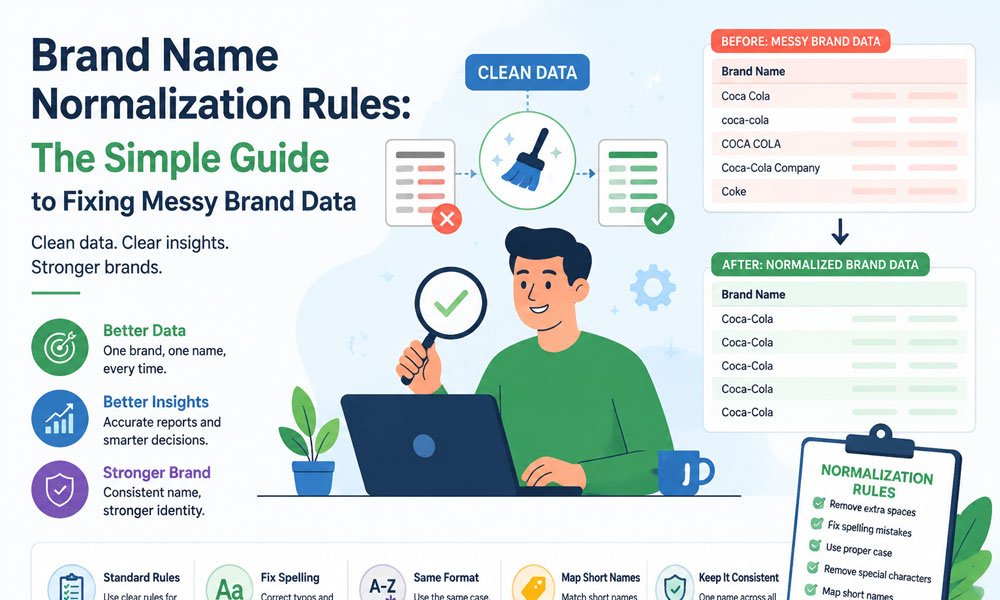
Imagine your sales team searching for a company in your CRM. They type “Acme” but cannot find the account they need. After checking again, they discover the same company already exists as “Acme Inc.,” “ACME Corporation,” and “Acme LLC.” The business was always there, but messy naming created confusion.
This problem happens in many companies every day. A single brand can have many versions because different people, tools, and systems enter names in different ways. Over time, these small changes create duplicate records, broken reports, and lost business insights.
This is where brand name normalization rules become useful. These rules help businesses create one clear and standard version of every brand name. Instead of having five different records for the same company, teams can work with one trusted name.
In this guide, we will explain what brand name normalization rules are, why they matter, and how businesses can use them to fix messy brand data. We will also look at the main rules, common mistakes, and simple ways to keep brand information clean in 2026.
What Are Brand Name Normalization Rules?
At the basic level, brand name normalization rules are a set of steps that help businesses make brand names consistent across their systems. These rules decide how a company name should appear in a database, CRM, website, or reporting tool.
When new data enters a system, it can come from many places. Someone may type a company name manually. A customer may fill out a form. A team may upload a spreadsheet. A third-party tool may send company information. Each source may write the same brand name in a different way.
For example, a database may have these records:
-
Microsoft Corporation
-
Microsoft Corp.
-
MICROSOFT
-
microsoft
A normalization system can turn all of them into one clean version:
Microsoft
The goal is not only to make names look better. The goal is to create reliable data that teams can trust. Clean brand names help companies understand their customers, track sales, and make smarter decisions.
Why Brand Name Normalization Rules Are Important
Messy brand data can create many hidden problems. A company may think it has many different customers when it actually has only one. Sales teams may contact the same business twice because they do not know duplicate records exist.
This can waste time and create a poor customer experience. A customer does not want to receive multiple messages from the same company just because their brand name was saved in different ways.
Brand name normalization rules help solve these problems by creating cleaner records. When every company has one standard name, teams can easily see the complete history of their relationship with that brand.
Another important benefit is better reporting. Imagine a business trying to check revenue from one customer account. If that customer appears under three or four different names, the report will not show the full picture.
With normalized data, companies can create better reports, improve customer segmentation, and understand their market more clearly. Clean data supports better decisions.
The First Step: Create One Official Brand Name
The first step in brand name normalization is choosing one official version of each brand name. This version is called the canonical name. It becomes the main name that all other versions connect to.
For example:
-
Apple Inc.
-
APPLE
-
Apple Computer
may all connect to:
Apple
Creating a single source of truth prevents confusion. Everyone in the company follows the same naming style instead of creating their own versions.
Many businesses create a master brand registry for this purpose. This registry contains the approved brand name, common variations, old names, and special rules.
A good brand registry answers simple questions:
-
What is the correct brand name?
-
Should the name include a legal suffix?
-
Does the brand use special letters or symbols?
-
Are there common mistakes to fix?
This list becomes the foundation of a clean data system.
Brand Name Normalization Rules for Removing Legal Words
Many companies include legal words in their official business names. These words are useful for legal documents, but they often create problems in everyday business data.
Common legal words include:
-
Inc.
-
Incorporated
-
Corporation
-
Corp.
-
LLC
-
Ltd.
-
Limited
-
GmbH
-
AG
-
SAS
For most customer-facing systems, these words can be removed.
Examples:
Salesforce, Inc. becomes:
Salesforce
HubSpot LLC becomes:
HubSpot
Deutsche Bank AG becomes:
Deutsche Bank
Removing these extra words makes matching easier. It helps systems understand that different versions belong to the same company.
However, businesses should be careful. Some brands use legal words as part of their identity. A company should not remove important parts of a brand name without checking first.
For this reason, many companies create exception lists. These lists protect special brand names that should stay unchanged.
Brand Name Normalization Rules for Capital Letters and Style
Capital letters may seem like a small detail, but they can create big problems in databases. Different systems may save the same brand with different letter styles.
Examples:
-
netflix
-
NETFLIX
-
Netflix
These should all become:
Netflix
The same applies to many other brands:
-
microsoft → Microsoft
-
google → Google
-
MicroSOFT → Microsoft
A standard style makes brand data easier to search and manage.
However, not every brand follows normal capitalization rules. Some brands have a special style that represents their identity.
Examples:
-
eBay
-
iPhone
-
adidas
-
IBM
-
BMW
Changing these names can make the brand look incorrect. Good brand name normalization rules should include special cases for these brands.
The best approach is simple: use normal formatting for common brands, but keep official styling when a brand has a unique identity.
Brand Name Normalization Rules for Symbols and Formatting
Symbols and small formatting changes can also create duplicate records. A brand may appear with different spaces, marks, or punctuation depending on where the data comes from.
For example:
-
Coca Cola
-
Coca-Cola
-
AT and T
-
AT&T
A good normalization system creates clear rules for handling these differences.
Common formatting rules include:
-
Remove extra spaces
-
Remove unnecessary commas
-
Keep official symbols
-
Keep important apostrophes
-
Follow official hyphen use
Examples:
Correct:
-
McDonald’s
-
Levi’s
-
AT&T
-
Rolls-Royce
Incorrect:
-
McDonalds
-
Levis
-
AT and T
-
Rolls Royce (when the official style uses a hyphen)
Small details matter because AI tools, search systems, and databases use these signals to understand whether two names belong to the same brand.
Brand Name Normalization Rules for Abbreviations and Short Names
Many companies appear in databases with both full names and short names. Sometimes people use the official company name, while others use a popular short version. This can create confusion if there are no clear rules.
For example:
- International Business Machines
- IBM
Both names refer to the same company. A good normalization system should know that these two names belong together and should map them to one standard name.
The same applies to other brands:
- Bayerische Motoren Werke → BMW
- Microsoft Corporation → Microsoft
However, not every short name should be changed. Some abbreviations are already the main identity of a brand.
Examples:
- IBM
- AT&T
- 3M
These names should stay the same because customers already recognize them.
Creating an alias list can help solve this problem. An alias list stores common versions of a brand and connects them to the correct standard name. This makes searching, reporting, and customer management much easier.
Handling Parent Companies, Subsidiaries, and Brand Groups
Many large companies own several smaller brands. This creates an important question: Should all brands be combined, or should they stay separate?
For example, Meta owns brands like Instagram and WhatsApp. Procter & Gamble owns brands like Tide, Gillette, and Pampers.
A company must decide how it wants to organize this information. There is no single rule that works for everyone.
Some businesses prefer parent-level tracking. In this case, different brands may connect back to the main company.
For example:
Instagram → Meta
This approach works well for companies that manage large business accounts and want a complete view of a corporate relationship.
Other businesses may want to keep brands separate. A marketing team may track Instagram differently from Meta because they are different platforms with different audiences.
A third option is creating links between companies. The brands stay separate, but the relationship is saved. This gives teams more flexibility.
Managing Regional and Global Brand Name Variations
Global companies often have different names in different countries. These differences can make brand data harder to manage.
For example:
- Google LLC
- Google UK Limited
- Google Ireland Limited
All of these names connect to Google, but they represent different legal entities.
Businesses need to decide what level of detail they need. Some companies only care about the main brand name. Others need regional information for contracts, taxes, or sales territories.
A good system keeps the right balance. It removes unnecessary differences while saving important information.
For global businesses, brand name normalization rules should include country-specific examples. A company working across many regions may need different rules for different markets.
How to Build a Brand Name Normalization System
Creating a clean brand database does not happen overnight. It requires a clear plan and regular updates.
The first step is checking your current data. Look at all existing brand names and find problems.
Ask questions like:
- How many duplicate brands exist?
- Which names appear in different forms?
- Which suffixes appear often?
- Where are the biggest mistakes?
This audit helps businesses understand where to start.
The next step is creating a master brand list. This list should include the approved brand name, common variations, old names, and special rules.
For example:
| Raw Name | Standard Name |
|---|---|
| Microsoft Corp. | Microsoft |
| MSFT | Microsoft |
| Google LLC | |
| Coca Cola Company | Coca-Cola |
Once this list is ready, businesses can create rules that automatically clean new data.
Building Simple Rules for Better Brand Data
A good normalization system follows rules in the right order. The order matters because one step can affect another.
A simple process may look like this:
- Remove extra spaces.
- Remove quotation marks.
- Remove unnecessary legal words.
- Fix punctuation.
- Apply correct capitalization.
- Check special brand exceptions.
Following these steps helps create predictable results.
Businesses should also create exception lists. Some brands do not follow normal naming patterns.
Examples:
- eBay
- adidas
- IKEA
- BMW
- AT&T
Without an exception list, automatic systems may change these names incorrectly.
Common Brand Name Normalization Mistakes to Avoid
While cleaning brand data is helpful, doing it the wrong way can create new problems.
One common mistake is matching too aggressively. A system may think two similar names belong to the same company when they are actually different.
For example:
- ABC Company
- ABC Corporation
These names may belong to the same business, or they may be completely different companies.
The safest approach is to review uncertain matches before combining records.
Another mistake is removing useful information. Some details may look unnecessary but still matter.
Examples:
- Country names
- Business divisions
- Legal entities
- Regional offices
Instead of deleting everything, keep the original information in a separate field.
A strong system can have:
- Normalized brand name
- Original company name
- Legal name
- Location details
This keeps data clean without losing important facts.
Brand Name Normalization Rules and AI Search in 2026
Brand consistency is becoming even more important because of AI search. Modern AI systems do not only look at words. They try to understand brands as complete entities.
If a brand appears in many different ways online, AI systems may struggle to connect all the information.
For example:
- Ad Pulse
- AdPulse
- Ad-Pulse
- Ad Pulse Media
A person may understand these are connected, but an AI system may see them as different names.
This is why brand name normalization rules are now important for online visibility. A consistent brand name helps AI tools understand who the company is and what information belongs to it.
Strong brand consistency can improve:
- Brand recognition
- Search visibility
- Online authority
- AI-generated mentions
Companies should use the same brand style across websites, social profiles, press releases, directories, and other online platforms.
How Brand Normalization Helps AI Visibility
AI search systems learn from many sources. They look at websites, business listings, articles, and other trusted information.
When a brand name stays consistent everywhere, AI can build a clearer picture of that company.
For example, if a company uses one name on:
- Website
- LinkedIn page
- News articles
- Business directories
AI has stronger signals that all these sources belong to the same brand.
But if every platform uses a different version, AI may become unsure.
This can lead to problems:
- The brand may not appear in answers.
- AI may use an old name.
- The brand may be linked with another company.
Clean naming helps protect brand identity in the changing world of AI search.
Automation vs Human Review for Brand Data Cleaning
Many parts of brand normalization can be automated. Computers are very good at handling simple tasks.
Automation can help with:
- Removing suffixes
- Fixing spaces
- Standardizing punctuation
- Correcting known variations
These tasks follow clear rules and usually do not need human decisions.
However, some situations need people to review the data.
Human review is useful for:
- Parent company decisions
- Unclear duplicates
- Important customer accounts
- Brand changes
The goal is not to remove humans from the process. The goal is to save time by letting technology handle simple work while people focus on decisions that need careful thinking.
Best Practices for Maintaining Clean Brand Data
Brand data needs regular care. A company may clean its database today, but new mistakes can appear tomorrow.
The best approach is to make normalization part of daily work.
Companies should:
- Check new brand entries
- Update their master brand list
- Review old records
- Train employees
- Monitor duplicate records
A clean system stays clean when everyone follows the same rules.
Businesses should also update their rules when brands change names, merge with other companies, or create new products.
Conclusion
Messy brand data can create hidden problems for businesses. Duplicate records, poor reports, and confused teams often start with something as simple as an inconsistent company name.
Brand name normalization rules help solve this problem by creating one clear and trusted version of every brand.
From removing extra legal words to fixing capitalization, symbols, and duplicate records, these rules make business data easier to manage.
In 2026, clean brand data is not only useful for companies. It also helps search engines and AI systems understand brands better.
A strong brand identity starts with a simple step: making sure your name is clear, consistent, and easy for everyone to recognize.
Continue reading: Platform Event Trap: 7 Common Problems and How to Fix Them