
 By Admin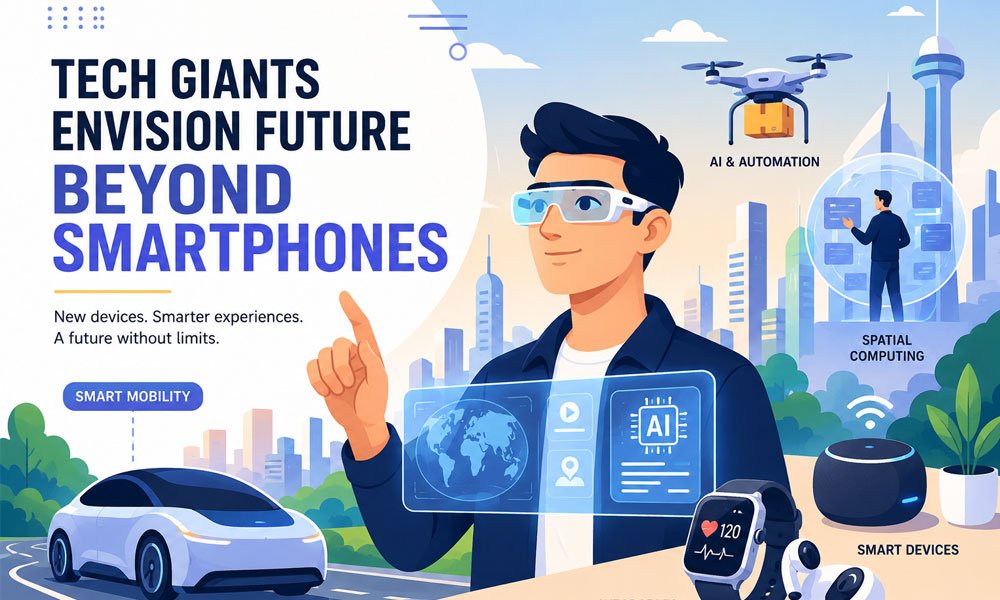
For almost 20 years, smartphones have been a big part of daily life. We use them to talk with friends, watch videos, take photos, find places, shop, study, and work. For many people, the phone is the first screen they check each morning.
But technology is changing again. Big companies are looking at smart glasses, AI helpers, watches, rings, and mixed reality devices. Their goal is simple. They want technology to help us without making us look at a phone screen all day.
This is why tech giants envision future beyond smartphones. In this article, we will look at what this future may mean. We will also explore AI, smart glasses, wearables, and the plans of companies such as Google, Meta, Samsung, and Apple.
Why Tech Giants Envision Future Beyond Smartphones
Smartphones are still very useful. They are also more powerful than ever. But the basic idea has stayed almost the same. We take a phone from our pocket, open an app, tap the screen, and put the phone away again.
New phone models still bring better cameras, faster chips, and smarter software. Yet, many yearly changes now feel small. This has pushed big tech companies to search for the next major change in personal technology.
AI has made that search much more exciting. A smart AI helper can listen to your voice and understand an image. It can answer questions and help with daily tasks. Because AI does not always need a phone screen, tech giants envision future beyond smartphones and other hand-held devices.
What the Future Beyond Smartphones Really Means
A future beyond smartphones does not mean everyone will throw away their phones. That is not likely to happen soon. Instead, some jobs we do on phones may slowly move to other devices.
Think about getting directions. Today, you may hold your phone while walking. In the future, glasses could show the next turn in front of your eyes. Earbuds could also tell you where to go. You would still get the same help without staring at a phone.
The same could happen with messages, calls, payments, photos, and AI searches. A watch may handle payments. Glasses may take photos. Earbuds may answer questions. The phone could remain in your pocket while other devices do more of its work.
How AI Is Changing the Smartphone Era
AI is one of the biggest reasons tech giants envision future beyond smartphones. Modern AI can understand much more than typed words. It can work with speech, photos, video, and other information.
Imagine walking past an old building while wearing AI glasses. You could ask, “What building is that?” The AI could use the camera to understand what you are looking at and give you an answer. You would not need to search for the building on your phone.
AI helpers may also make apps less important for simple jobs. Instead of opening several apps, you could simply ask an AI helper to create a reminder, find information, write a short message, or plan a route. The goal is to make technology feel easier and more natural.
Smart Glasses and the Future Beyond Smartphones
Smart glasses are one of the most interesting devices in this new race. The idea is easy to understand. People already wear normal glasses every day. Adding useful technology to them could bring digital help closer to our eyes and ears.
Smart glasses can already offer features such as cameras, speakers, voice help, and AI. More advanced glasses can also show digital information. In time, this could help with maps, messages, live translation, photos, and quick answers.
This does not mean glasses are ready to replace phones. Battery life, price, comfort, privacy, and design are still big issues. But glasses do not need to replace every phone feature to become useful. If they stop people from taking out their phones 20 or 30 times a day, that alone could change daily habits.
How Meta Sees a Future Beyond Smartphones
Meta has become an important company in the smart glasses market. Its work with Ray-Ban has helped make AI glasses look more like normal eyewear. Users can take photos, record video, listen to audio, make calls, and use AI features.
Meta is also exploring glasses with displays. A small display could make glasses much more useful because information could appear in front of the user. Directions, messages, translations, and other short pieces of information could be seen without opening a phone.
Meta has also shown its Orion AR glasses project. Orion gives us a look at a more advanced future where digital objects can appear in the world around us. The technology is still developing, but it shows why tech giants envision future beyond smartphones rather than simply building better phone screens.
Google and Samsung Build Beyond Smartphones
Google is taking a wide approach to the same idea. Android XR is designed for new devices such as headsets and smart glasses. Google is also bringing Gemini AI into these experiences.
The idea could make AI more useful in the real world. Imagine wearing glasses and asking Gemini about something you can see. The glasses could help with directions, messages, photos, translation, and questions without making you stop and use a phone.
Samsung is also part of this new push. Its XR work shows that Google and Samsung are thinking beyond one single product. They want hardware, AI, apps, and software to work together. This type of ecosystem could play a major role in a future where the phone is no longer at the center.
Apple and the Future Beyond Smartphones
Apple has taken a different path with Vision Pro. Vision Pro is much larger than normal glasses, so it is not a simple phone replacement. However, it shows how Apple thinks computing could work without a normal screen.
With spatial computing, apps do not have to stay inside a phone or computer display. Digital windows can appear around the user. People can control them with their eyes, hands, and voice. This changes the way we think about screens.
Vision Pro also shows what still needs to improve. Future devices would need to become lighter, easier to wear, and less costly for wide daily use. Still, the basic idea is important. Instead of carrying every digital experience on one small screen, computing could become part of the space around us.
Wearables Help Tech Giants Move Beyond Smartphones
Wearable devices are already part of daily life. Smartwatches can show messages, track steps, take calls, and help with payments. Smart rings can track sleep and other body signals. Earbuds can also give voice help without making you look at a screen.
These devices show why tech giants envision future beyond smartphones. A watch can handle a quick payment. Earbuds can read a message. Smart glasses can give directions. Each device can take over a small job that once needed a phone.
The big change may happen when these devices work together. Your watch, glasses, earbuds, home, and car could share useful information with your AI helper. The phone may still be there, but you may need to touch it far less often.
Spatial Computing Could Replace Phone Screens
Spatial computing brings digital content into the space around us. Instead of seeing everything on a small phone screen, people can view digital windows and objects in a larger space. AR, VR, and mixed reality are all helping this idea grow.
This could be useful in many areas. A student could study a 3D model instead of looking at a flat picture. A worker could place several digital screens around a desk. Someone visiting a new city could see useful directions in front of them.
The goal is not only to build a bigger screen. It is to make digital tools fit into the real world. Eye tracking, hand movements, gestures, and voice could replace some taps and swipes. This is one reason spatial computing is important to the post-smartphone future.
Ambient AI and the Future Beyond Smartphones
Ambient AI sounds complex, but the idea is simple. It means smart technology works quietly around you. You do not have to keep opening apps and giving the same commands again and again.
Imagine getting ready for school or work. Your AI helper could tell you about rain through your earbuds. Your watch could show your next event. Your glasses could give directions when you leave home. These tools could work together without making you stare at one screen.
This helps explain why tech giants envision future beyond smartphones. The aim is to make technology less visible but more useful. However, people must stay in control. They should know when devices are listening, watching, saving, or sharing information.
Brain-Computer Interfaces and Life Beyond Smartphones
Brain-computer interfaces, or BCIs, take this idea much further. A BCI creates a direct link between brain signals and a computer. Today, much of this work is focused on medical needs rather than replacing consumer phones.
Neuralink is one well-known company working in this area. Other research groups are also studying BCIs. One important goal is helping people with serious movement limits control computers and other devices.
BCIs should not be treated as the next smartphone just yet. Safety, surgery, privacy, cost, and rules are major issues. The technology is still early. It shows what may one day be possible, but smart glasses and normal wearables are much closer to everyday use in 2026.
What Is Stopping a Future Beyond Smartphones?
There is a lot of excitement around new devices, but several problems remain. Battery life is one of the biggest. A phone has space for a large battery. Thin glasses and small rings have far less room.
Comfort matters too. People will not want to wear heavy glasses all day. Price is another issue. A new device may have amazing features, but it cannot become common if most people cannot afford it.
Privacy may be an even bigger test. Smart glasses can have cameras and microphones. Wearables can collect personal information. AI may also use data about what users see and do. Companies will need clear privacy controls if they want people to trust these products.
There is also the problem of phone dependence. Some wearables still need a nearby smartphone for certain jobs. A true phone replacement would need its own strong connection, useful apps, enough power, and simple controls.
When Could Smartphones Lose Their Main Role?
There is no trusted date for the end of the smartphone. Predictions such as 2030 or 2035 can be interesting, but they should not be treated as promises. Technology can move quickly, while people’s habits can take much longer to change.
Before 2030, we may see more phone tasks move to AI glasses, watches, earbuds, and other wearables. Directions and quick AI questions are good examples. Messages, calls, photos, translation, payments, and alerts could also move away from the phone screen.
Change may also happen at different speeds around the world. New devices can be costly at first. Fast networks and other services are not the same everywhere. Smartphones may therefore remain very important in many places even as richer markets try newer devices.
Tech Giants Envision Future Beyond Smartphones: What Comes Next?
Different companies are taking different paths. Meta is pushing AI glasses and AR. Google and Samsung are building around Android XR and AI. Apple is exploring spatial computing. Qualcomm is working on chips that can make smaller smart devices more powerful.
OpenAI is another company worth watching because it is exploring AI-focused hardware. Microsoft has years of mixed reality work behind it. Neuralink is looking much further ahead with brain-computer interfaces. These companies do not all have the same plan, but they are testing new ways for humans to use computers.
The winner may not be one single device. Smart glasses could handle visual information. A watch or ring could manage health and identity. Earbuds could become a voice link to AI. Other screens could appear only when needed. This wider ecosystem may be what truly comes after the smartphone.
Conclusion
The way we use technology is starting to change. Smartphones are still at the center of digital life in 2026, and they are not about to vanish. Yet, their long-term role is becoming less certain as other devices become smarter.
AI glasses, wearables, spatial computing, and ambient AI could slowly take over many phone jobs. BCIs may bring even bigger changes much later. Battery life, price, comfort, privacy, and trust must still improve before any of these tools can truly challenge smartphones.
This is why tech giants envision future beyond smartphones. The biggest change may not be the day phones disappear. It may be the day we notice that our phone stayed in our pocket because other devices already did everything we needed.
Continue reading: What Would Be an Appropriate Task for Using Generative AI?